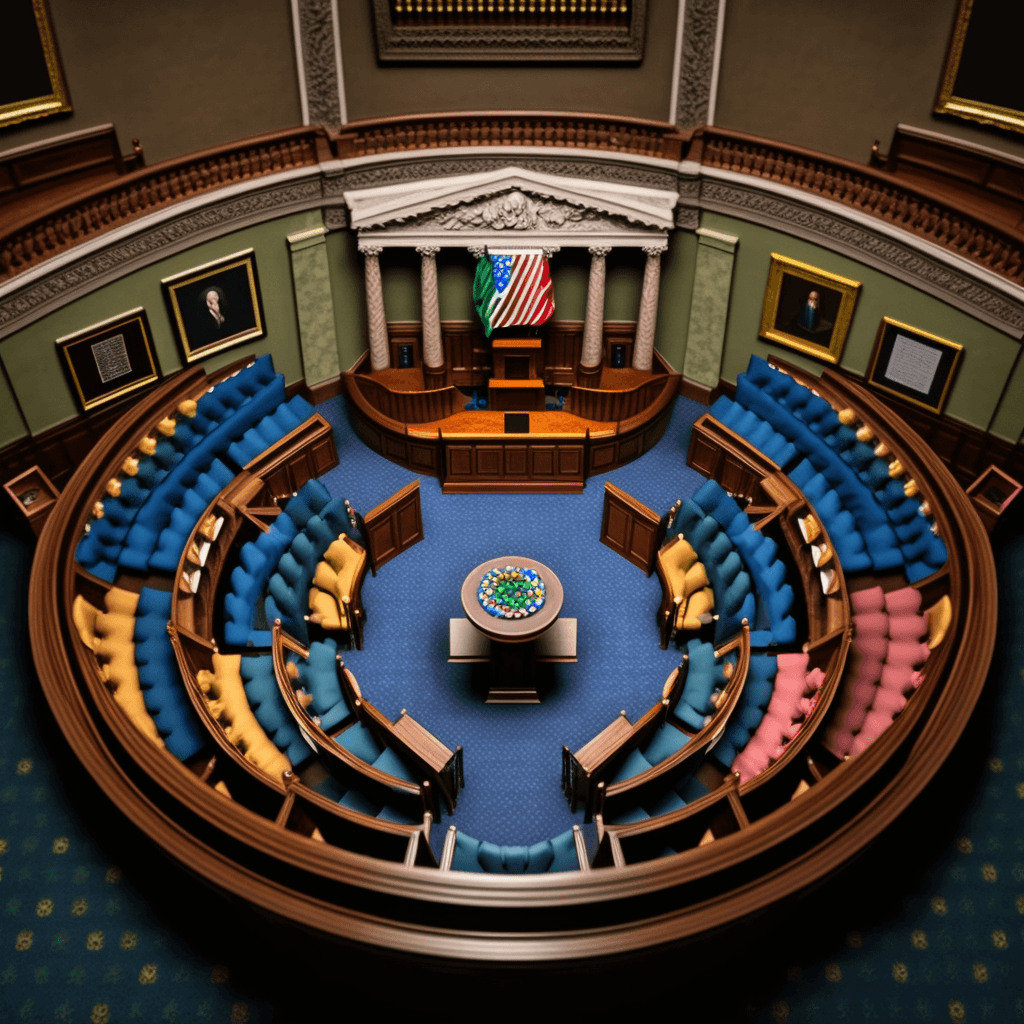
The House of Representatives and How it is Constituted
by James Madison
Generated summaryMadison lays out the House of Representatives piece by piece: who can vote and serve, why two-year terms work, how seats and taxes are apportioned including the three-fifths compromise, and why its size, though modest, is safe, well-informed, and built to grow.
Federalist 52
Generated summaryVoters for the House must meet the standard their own State sets for its largest legislative chamber. Representatives must be twenty-five, a citizen of seven years, and a resident of their State, and they serve two years.Key points
The House is soundly constituted: its electors and members are properly qualified, and its two-year term is safe.
Voters must meet each State’s own standard for its most numerous legislative branch, a suffrage the Constitution fixes.
A member must be twenty-five, seven years a citizen, an inhabitant, and hold no other federal office.
Liberty requires this branch to depend on and sympathize with the people, which only frequent elections secure.
Experience in Britain, Ireland, and the colonies shows biennial elections cannot endanger that dependence.
Three circumstances confirm it: the House holds only part of the legislative power, the States watch it, and it is hard to corrupt.
I begin with the House of Representatives, and with who may vote and who may serve. Voters must meet the standard their State sets for its most numerous legislative branch. Suffrage is a fundamental article of republican government, so the convention had to fix it in the Constitution. Congress could not be left to settle it. Nor could the State legislatures, for this branch must depend on the people alone. One rule for every State would probably have displeased some. The rule chosen suits every State, since it follows the State’s own standard. It is safe too, since State governments cannot alter what their constitutions fix.
OriginalFROM the more general inquiries pursued in the four last papers, I pass on to a more particular examination of the several parts of the government. I shall begin with the House of Representatives. The first view to be taken of this part of the government relates to the qualifications of the electors and the elected. Those of the former are to be the same with those of the electors of the most numerous branch of the State legislatures. The definition of the right of suffrage is very justly regarded as a fundamental article of republican government. It was incumbent on the convention, therefore, to define and establish this right in the Constitution.
To have left it open for the occasional regulation of the Congress, would have been improper for the reason just mentioned. To have submitted it to the legislative discretion of the States, would have been improper for the same reason; and for the additional reason that it would have rendered too dependent on the State governments that branch of the federal government which ought to be dependent on the people alone. To have reduced the different qualifications in the different States to one uniform rule, would probably have been as dissatisfactory to some of the States as it would have been difficult to the convention. The provision made by the convention appears, therefore, to be the best that lay within their option. It must be satisfactory to every State, because it is conformable to the standard already established, or which may be established, by the State itself. It will be safe to the United States, because, being fixed by the State constitutions, it is not alterable by the State governments, and it cannot be feared that the people of the States will alter this part of their constitutions in such a manner as to abridge the rights secured to them by the federal Constitution.
The State constitutions define the qualifications of the elected less carefully, and one rule fits them more easily. So the convention has settled them. A representative must be twenty-five and a citizen of seven years. He must live in the State he represents when elected, and hold no other office under the United States while serving. Within these limits the office is open to merit of every kind: native or naturalized, young or old, poor or rich, of any religious faith. Now the term of election. Two questions decide it: are elections every two years safe, and are they needed or useful?
OriginalThe qualifications of the elected, being less carefully and properly defined by the State constitutions, and being at the same time more susceptible of uniformity, have been very properly considered and regulated by the convention. A representative of the United States must be of the age of twenty-five years; must have been seven years a citizen of the United States; must, at the time of his election, be an inhabitant of the State he is to represent; and, during the time of his service, must be in no office under the United States. Under these reasonable limitations, the door of this part of the federal government is open to merit of every description, whether native or adoptive, whether young or old, and without regard to poverty or wealth, or to any particular profession of religious faith.
The term for which the representatives are to be elected falls under a second view which may be taken of this branch. In order to decide on the propriety of this article, two questions must be considered: first, whether biennial elections will, in this case, be safe; secondly, whether they be necessary or useful.
First, safety. Liberty requires that government share the people’s interest, and this branch above all must depend on the people and feel with them. Frequent elections alone secure that, and no exact rule can fix how frequent. Let us consult experience, the guide we should follow wherever it can be found. Representation was barely known to the ancients, so I take the modern cases nearest our own. Take first the House of Commons in Great Britain. Its earliest records show that parliaments were to sit each year, not be elected each year. Even those sittings lay at the monarch’s will, and royal ambition often contrived long, dangerous breaks.
OriginalFirst. As it is essential to liberty that the government in general should have a common interest with the people, so it is particularly essential that the branch of it under consideration should have an immediate dependence on, and an intimate sympathy with, the people. Frequent elections are unquestionably the only policy by which this dependence and sympathy can be effectually secured. But what particular degree of frequency may be absolutely necessary for the purpose, does not appear to be susceptible of any precise calculation, and must depend on a variety of circumstances with which it may be connected. Let us consult experience, the guide that ought always to be followed whenever it can be found.
The scheme of representation, as a substitute for a meeting of the citizens in person, being at most but very imperfectly known to ancient polity, it is in more modern times only that we are to expect instructive examples. And even here, in order to avoid a research too vague and diffusive, it will be proper to confine ourselves to the few examples which are best known, and which bear the greatest analogy to our particular case. The first to which this character ought to be applied, is the House of Commons in Great Britain. The history of this branch of the English Constitution, anterior to the date of Magna Charta, is too obscure to yield instruction. The very existence of it has been made a question among political antiquaries. The earliest records of subsequent date prove that parliaments were to SIT only every year; not that they were to be ELECTED every year. And even these annual sessions were left so much at the discretion of the monarch, that, under various pretexts, very long and dangerous intermissions were often contrived by royal ambition.
The remedy came by degrees. A statute under Charles II barred these breaks beyond three years. Under William III it was declared a fundamental right that parliaments be held frequently, and a later statute fixed three years. Early in this century the term rose to seven. So three years was the most frequent election that kingdom ever thought necessary. Much liberty survived even under seven-year elections, with that constitution’s other vices. If we may argue from that, cutting seven to three, with the other needed reforms, would greatly extend the people’s hold. Elections every two years, then, cannot possibly endanger the House’s dependence on its constituents.
OriginalTo remedy this grievance, it was provided by a statute in the reign of Charles II, that the intermissions should not be protracted beyond a period of three years. On the accession of William III, when a revolution took place in the government, the subject was still more seriously resumed, and it was declared to be among the fundamental rights of the people that parliaments ought to be held FREQUENTLY. By another statute, which passed a few years later in the same reign, the term "frequently," which had alluded to the triennial period settled in the time of Charles II, is reduced to a precise meaning, it being expressly enacted that a new parliament shall be called within three years after the termination of the former. The last change, from three to seven years, is well known to have been introduced pretty early in the present century, under an alarm for the Hanoverian succession. From these facts it appears that the greatest frequency of elections which has been deemed necessary in that kingdom, for binding the representatives to their constituents, does not exceed a triennial return of them. And if we may argue from the degree of liberty retained even under septennial elections, and all the other vicious ingredients in the parliamentary constitution, we cannot doubt that a reduction of the period from seven to three years, with the other necessary reforms, would so far extend the influence of the people over their representatives as to satisfy us that biennial elections, under the federal system, cannot possibly be dangerous to the requisite dependence of the House of Representatives on their constituents.
In Ireland, elections long lay at the crown’s will. The parliament begun under George II ran his whole reign, some thirty-five years. If the Irish kept any liberty under such burdens, elections every two years would secure every liberty that rests on a due tie between representatives and people. Nearer home, each colony had representation in at least one branch, with terms of one to seven years. The spirit that overcame every obstacle to independence proves liberty enough was enjoyed everywhere. Virginia stood first in resisting Britain’s usurpations, yet its elections ran every seven years. I offer that as proof, and I think substantial proof, that elections every two years leave liberty in no danger.
OriginalElections in Ireland, till of late, were regulated entirely by the discretion of the crown, and were seldom repeated, except on the accession of a new prince, or some other contingent event. The parliament which commenced with George II. was continued throughout his whole reign, a period of about thirty-five years. The only dependence of the representatives on the people consisted in the right of the latter to supply occasional vacancies by the election of new members, and in the chance of some event which might produce a general new election. The ability also of the Irish parliament to maintain the rights of their constituents, so far as the disposition might exist, was extremely shackled by the control of the crown over the subjects of their deliberation. Of late these shackles, if I mistake not, have been broken; and octennial parliaments have besides been established. What effect may be produced by this partial reform, must be left to further experience. The example of Ireland, from this view of it, can throw but little light on the subject. As far as we can draw any conclusion from it, it must be that if the people of that country have been able under all these disadvantages to retain any liberty whatever, the advantage of biennial elections would secure to them every degree of liberty, which might depend on a due connection between their representatives and themselves.
Let us bring our inquiries nearer home. The example of these States, when British colonies, claims particular attention, at the same time that it is so well known as to require little to be said on it. The principle of representation, in one branch of the legislature at least, was established in all of them. But the periods of election were different. They varied from one to seven years. Have we any reason to infer, from the spirit and conduct of the representatives of the people, prior to the Revolution, that biennial elections would have been dangerous to the public liberties? The spirit which everywhere displayed itself at the commencement of the struggle, and which vanquished the obstacles to independence, is the best of proofs that a sufficient portion of liberty had been everywhere enjoyed to inspire both a sense of its worth and a zeal for its proper enlargement
This remark holds good, as well with regard to the then colonies whose elections were least frequent, as to those whose elections were most frequent Virginia was the colony which stood first in resisting the parliamentary usurpations of Great Britain; it was the first also in espousing, by public act, the resolution of independence. In Virginia, nevertheless, if I have not been misinformed, elections under the former government were septennial. This particular example is brought into view, not as a proof of any peculiar merit, for the priority in those instances was probably accidental; and still less of any advantage in SEPTENNIAL elections, for when compared with a greater frequency they are inadmissible; but merely as a proof, and I conceive it to be a very substantial proof, that the liberties of the people can be in no danger from BIENNIAL elections.
Three things strengthen this. First, the federal legislature will hold only part of the supreme lawmaking power. The British Parliament held it whole, and the colonial and Irish legislatures nearly so. By a sound maxim, all else equal, the greater the power the shorter its term, and the smaller the longer. Second, it is restrained by dependence on the people, as others are, and watched besides by the State legislatures, a check others lack. Third, the lasting branches of this government have far less means of seducing the House than those governments had over their popular branch. With less power to abuse, the federal representatives are less tempted on one side and doubly watched on the other.
OriginalThe conclusion resulting from these examples will be not a little strengthened by recollecting three circumstances. The first is, that the federal legislature will possess a part only of that supreme legislative authority which is vested completely in the British Parliament; and which, with a few exceptions, was exercised by the colonial assemblies and the Irish legislature. It is a received and well-founded maxim, that where no other circumstances affect the case, the greater the power is, the shorter ought to be its duration; and, conversely, the smaller the power, the more safely may its duration be protracted.
In the second place, it has, on another occasion, been shown that the federal legislature will not only be restrained by its dependence on its people, as other legislative bodies are, but that it will be, moreover, watched and controlled by the several collateral legislatures, which other legislative bodies are not. And in the third place, no comparison can be made between the means that will be possessed by the more permanent branches of the federal government for seducing, if they should be disposed to seduce, the House of Representatives from their duty to the people, and the means of influence over the popular branch possessed by the other branches of the government above cited. With less power, therefore, to abuse, the federal representatives can be less tempted on one side, and will be doubly watched on the other. PUBLIUS
Federalist 53
Generated summaryTwo-year terms are safe, because a Constitution the government cannot change already guards liberty. They are also useful, because federal lawmaking spans the laws, trade, and foreign affairs of every state, and that takes time to learn.Key points
The proverb favoring annual elections does not bind America, and biennial elections are both safe and useful.
Proverbs rest on a reason but get stretched past it; nature ties liberty to no point on the calendar.
State terms already vary fourfold, from half a year to two, with no difference in liberty.
The proverb’s one ground is fear of a legislature that can alter its own election law, as Britain’s can.
But our Constitution stands above the government and cannot be changed by it, so that fear does not reach us.
Competent legislating requires knowledge that only experience in office supplies.
Federal business, far more varied and complex than a single State’s, justifies the longer, two-year term.
I shall be reminded of the saying that “where annual elections end, tyranny begins.” Proverbs generally rest on reason, yet they are often stretched to cases the reason does not cover. Nothing in nature ties the sun or the seasons to the span in which virtue can bear the temptations of power. Liberty is not fixed to any single point on the calendar. If circumstances justify departing from the rule one way, why not the other?
Our own terms agree no better. Connecticut and Rhode Island elect their most numerous branch every half year, most states yearly, and South Carolina every two years, as proposed here. Across that fourfold spread, no one could easily show that Connecticut or Rhode Island is better governed, or freer, than South Carolina.
OriginalI SHALL here, perhaps, be reminded of a current observation, "that where annual elections end, tyranny begins." If it be true, as has often been remarked, that sayings which become proverbial are generally founded in reason, it is not less true, that when once established, they are often applied to cases to which the reason of them does not extend. I need not look for a proof beyond the case before us. What is the reason on which this proverbial observation is founded? No man will subject himself to the ridicule of pretending that any natural connection subsists between the sun or the seasons, and the period within which human virtue can bear the temptations of power. Happily for mankind, liberty is not, in this respect, confined to any single point of time; but lies within extremes, which afford sufficient latitude for all the variations which may be required by the various situations and circumstances of civil society. The election of magistrates might be, if it were found expedient, as in some instances it actually has been, daily, weekly, or monthly, as well as annual; and if circumstances may require a deviation from the rule on one side, why not also on the other side?
Turning our attention to the periods established among ourselves, for the election of the most numerous branches of the State legislatures, we find them by no means coinciding any more in this instance, than in the elections of other civil magistrates. In Connecticut and Rhode Island, the periods are half-yearly. In the other States, South Carolina excepted, they are annual. In South Carolina they are biennial--as is proposed in the federal government. Here is a difference, as four to one, between the longest and shortest periods; and yet it would be not easy to show, that Connecticut or Rhode Island is better governed, or enjoys a greater share of rational liberty, than South Carolina; or that either the one or the other of these States is distinguished in these respects, and by these causes, from the States whose elections are different from both.
I find one ground for this doctrine, and it does not fit our case. America understands a distinction barely grasped elsewhere: the people set a Constitution the government cannot alter; the government sets laws it may alter. Wherever the supreme power to legislate has resided, the power to change the government’s form has been assumed to reside there too. In Great Britain, Parliament has used it to lengthen the period between elections.
Such practices alarmed the friends of free government, whose cornerstone is frequent elections. Having no Constitution above their government, they sought another safeguard: a familiar span of time to measure the danger of change. A year was the simplest; hence the doctrine that the advance toward tyranny is measured by distance from annual elections. Why apply that expedient where a Constitution already limits the government? Who will claim Americans less secure under two-year terms fixed beyond change than a nation whose more frequent elections its government may alter?
OriginalIn searching for the grounds of this doctrine, I can discover but one, and that is wholly inapplicable to our case. The important distinction so well understood in America, between a Constitution established by the people and unalterable by the government, and a law established by the government and alterable by the government, seems to have been little understood and less observed in any other country. Wherever the supreme power of legislation has resided, has been supposed to reside also a full power to change the form of the government. Even in Great Britain, where the principles of political and civil liberty have been most discussed, and where we hear most of the rights of the Constitution, it is maintained that the authority of the Parliament is transcendent and uncontrollable, as well with regard to the Constitution, as the ordinary objects of legislative provision.
They have accordingly, in several instances, actually changed, by legislative acts, some of the most fundamental articles of the government. They have in particular, on several occasions, changed the period of election; and, on the last occasion, not only introduced septennial in place of triennial elections, but by the same act, continued themselves in place four years beyond the term for which they were elected by the people. An attention to these dangerous practices has produced a very natural alarm in the votaries of free government, of which frequency of elections is the corner-stone; and has led them to seek for some security to liberty, against the danger to which it is exposed.
Where no Constitution, paramount to the government, either existed or could be obtained, no constitutional security, similar to that established in the United States, was to be attempted. Some other security, therefore, was to be sought for; and what better security would the case admit, than that of selecting and appealing to some simple and familiar portion of time, as a standard for measuring the danger of innovations, for fixing the national sentiment, and for uniting the patriotic exertions? The most simple and familiar portion of time, applicable to the subject was that of a year; and hence the doctrine has been inculcated by a laudable zeal, to erect some barrier against the gradual innovations of an unlimited government, that the advance towards tyranny was to be calculated by the distance of departure from the fixed point of annual elections.
But what necessity can there be of applying this expedient to a government limited, as the federal government will be, by the authority of a paramount Constitution? Or who will pretend that the liberties of the people of America will not be more secure under biennial elections, unalterably fixed by such a Constitution, than those of any other nation would be, where elections were annual, or even more frequent, but subject to alterations by the ordinary power of the government?
The second question: are two-year terms needed or useful? No man makes laws well without honest aims, sound judgment, and knowledge of his subjects. Part of that knowledge anyone may gather; part comes only from experience in office. Length of service should therefore bear some proportion to the practical knowledge the work requires. Most states give their popular branch one year. Does two years bear no greater proportion to federal knowledge than one year to state knowledge? The question answers itself.
OriginalThe second question stated is, whether biennial elections be necessary or useful. The propriety of answering this question in the affirmative will appear from several very obvious considerations. No man can be a competent legislator who does not add to an upright intention and a sound judgment a certain degree of knowledge of the subjects on which he is to legislate. A part of this knowledge may be acquired by means of information which lie within the compass of men in private as well as public stations. Another part can only be attained, or at least thoroughly attained, by actual experience in the station which requires the use of it. The period of service, ought, therefore, in all such cases, to bear some proportion to the extent of practical knowledge requisite to the due performance of the service.
The period of legislative service established in most of the States for the more numerous branch is, as we have seen, one year. The question then may be put into this simple form: does the period of two years bear no greater proportion to the knowledge requisite for federal legislation than one year does to the knowledge requisite for State legislation? The very statement of the question, in this form, suggests the answer that ought to be given to it.
In a single state the laws are uniform and the affairs narrow. The Union is a different scene. Its laws vary in every state, and its affairs, spread over a vast region and varied by local matters, can be learned only in the central councils. Yet each member ought to know something of every state’s laws. How regulate foreign trade without knowing each state’s commerce and ports? Trade between states, without their relative situations? Taxes, without their differing laws? The militia, without their local differences? These chief objects show how much a representative must learn.
OriginalIn a single State, the requisite knowledge relates to the existing laws which are uniform throughout the State, and with which all the citizens are more or less conversant; and to the general affairs of the State, which lie within a small compass, are not very diversified, and occupy much of the attention and conversation of every class of people. The great theatre of the United States presents a very different scene. The laws are so far from being uniform, that they vary in every State; whilst the public affairs of the Union are spread throughout a very extensive region, and are extremely diversified by the local affairs connected with them, and can with difficulty be correctly learnt in any other place than in the central councils to which a knowledge of them will be brought by the representatives of every part of the empire.
Yet some knowledge of the affairs, and even of the laws, of all the States, ought to be possessed by the members from each of the States. How can foreign trade be properly regulated by uniform laws, without some acquaintance with the commerce, the ports, the usages, and the regulations of the different States? How can the trade between the different States be duly regulated, without some knowledge of their relative situations in these and other respects? How can taxes be judiciously imposed and effectually collected, if they be not accommodated to the different laws and local circumstances relating to these objects in the different States? How can uniform regulations for the militia be duly provided, without a similar knowledge of many internal circumstances by which the States are distinguished from each other? These are the principal objects of federal legislation, and suggest most forcibly the extensive information which the representatives ought to acquire. The other interior objects will require a proportional degree of information with regard to them.
These difficulties will lessen. The hardest task is launching the government and forming the first body of federal law; later improvements grow easier and fewer. Past acts will inform new members, and wider dealings among the states will spread mutual knowledge. Even so, federal lawmaking stays so much more novel and difficult than a single state’s as to justify the longer term.
One branch remains: foreign affairs. To regulate our own commerce, a representative should know our treaties and other nations’ commercial laws. He should not be ignorant of the law of nations, which is committed to the federal government. The House takes no direct part in foreign negotiations, yet these matters often touch ordinary lawmaking and sometimes need its sanction. Such knowledge is best acquired by practical service.
OriginalIt is true that all these difficulties will, by degrees, be very much diminished. The most laborious task will be the proper inauguration of the government and the primeval formation of a federal code. Improvements on the first draughts will every year become both easier and fewer. Past transactions of the government will be a ready and accurate source of information to new members. The affairs of the Union will become more and more objects of curiosity and conversation among the citizens at large. And the increased intercourse among those of different States will contribute not a little to diffuse a mutual knowledge of their affairs, as this again will contribute to a general assimilation of their manners and laws. But with all these abatements, the business of federal legislation must continue so far to exceed, both in novelty and difficulty, the legislative business of a single State, as to justify the longer period of service assigned to those who are to transact it.
A branch of knowledge which belongs to the acquirements of a federal representative, and which has not been mentioned is that of foreign affairs. In regulating our own commerce he ought to be not only acquainted with the treaties between the United States and other nations, but also with the commercial policy and laws of other nations. He ought not to be altogether ignorant of the law of nations; for that, as far as it is a proper object of municipal legislation, is submitted to the federal government. And although the House of Representatives is not immediately to participate in foreign negotiations and arrangements, yet from the necessary connection between the several branches of public affairs, those particular branches will frequently deserve attention in the ordinary course of legislation, and will sometimes demand particular legislative sanction and co-operation. Some portion of this knowledge may, no doubt, be acquired in a man's closet; but some of it also can only be derived from the public sources of information; and all of it will be acquired to best effect by a practical attention to the subject during the period of actual service in the legislature.
Many representatives must travel far, and the arrangements that forces might tell far more with fit men under one year than under two. A few members will have superior talents. By frequent re-election they become masters of public business, perhaps not unwilling to use those advantages. The more new members, and the less informed the rest, the readier they fall into the snares laid for them. The same holds between the House of Representatives and the Senate.
OriginalThere are other considerations, of less importance, perhaps, but which are not unworthy of notice. The distance which many of the representatives will be obliged to travel, and the arrangements rendered necessary by that circumstance, might be much more serious objections with fit men to this service, if limited to a single year, than if extended to two years. No argument can be drawn on this subject, from the case of the delegates to the existing Congress. They are elected annually, it is true; but their re-election is considered by the legislative assemblies almost as a matter of course. The election of the representatives by the people would not be governed by the same principle.
A few of the members, as happens in all such assemblies, will possess superior talents; will, by frequent reelections, become members of long standing; will be thoroughly masters of the public business, and perhaps not unwilling to avail themselves of those advantages. The greater the proportion of new members, and the less the information of the bulk of the members the more apt will they be to fall into the snares that may be laid for them. This remark is no less applicable to the relation which will subsist between the House of Representatives and the Senate.
Frequent elections carry a drawback even in large states that meet once a year: a false election cannot be overturned in time to matter. Whoever obtains a seat by unlawful means holds it long enough for his purpose, which encourages the practice. Were federal elections annual, this might become a serious abuse. Each house judges the elections, qualifications, and returns of its own members. Yet so much of a year would pass before a false member could be removed that the prospect little deters him. All this warrants us in affirming that two-year terms are as useful to the public business as we have seen them safe for the people’s liberty.
OriginalIt is an inconvenience mingled with the advantages of our frequent elections even in single States, where they are large, and hold but one legislative session in a year, that spurious elections cannot be investigated and annulled in time for the decision to have its due effect. If a return can be obtained, no matter by what unlawful means, the irregular member, who takes his seat of course, is sure of holding it a sufficient time to answer his purposes. Hence, a very pernicious encouragement is given to the use of unlawful means, for obtaining irregular returns. Were elections for the federal legislature to be annual, this practice might become a very serious abuse, particularly in the more distant States.
Each house is, as it necessarily must be, the judge of the elections, qualifications, and returns of its members; and whatever improvements may be suggested by experience, for simplifying and accelerating the process in disputed cases, so great a portion of a year would unavoidably elapse, before an illegitimate member could be dispossessed of his seat, that the prospect of such an event would be little check to unfair and illicit means of obtaining a seat. All these considerations taken together warrant us in affirming, that biennial elections will be as useful to the affairs of the public as we have seen that they will be safe to the liberty of the people. PUBLIUS
Federalist 54
Generated summaryThe same population count fixes both representation and direct taxes. Slaves are counted at three fifths, a compromise the paper ties to the mixed character the laws give them: persons in some respects, property in others.Key points
Representatives are apportioned among the States by population, the same rule that governs direct taxes.
Population is the agreed measure of representation; for taxation the rule stands in for wealth, which numbers gauge poorly.
The objection: slaves are property, not persons, so they should count for taxation but not representation.
The Southern reply: the laws treat slaves as both persons and property, so that mixed character is their true one.
The Constitution’s compromise counts each slave as three fifths of a free inhabitant.
One measure for both representation and taxation checks any State’s temptation to over- or under-count its people.
My next subject is how each State’s representatives are apportioned: by the same rule that fixes direct taxes. No one disputes that population should set each State’s representation. The two rules rest on different principles, though: representation marks the people’s personal rights; taxation their share of wealth, which numbers measure poorly. Yet no workable rule is less objectionable, and America’s recent approval won the convention’s preference. All this is admitted, an objector says. But must slaves enter the numerical rule of representation? They are property, not persons: fit for a tax founded on property, not for a count of persons. I state the other side as candidly.
OriginalTHE next view which I shall take of the House of Representatives relates to the appointment of its members to the several States which is to be determined by the same rule with that of direct taxes. It is not contended that the number of people in each State ought not to be the standard for regulating the proportion of those who are to represent the people of each State. The establishment of the same rule for the appointment of taxes, will probably be as little contested; though the rule itself in this case, is by no means founded on the same principle. In the former case, the rule is understood to refer to the personal rights of the people, with which it has a natural and universal connection. In the latter, it has reference to the proportion of wealth, of which it is in no case a precise measure, and in ordinary cases a very unfit one. But notwithstanding the imperfection of the rule as applied to the relative wealth and contributions of the States, it is evidently the least objectionable among the practicable rules, and had too recently obtained the general sanction of America, not to have found a ready preference with the convention.
All this is admitted, it will perhaps be said; but does it follow, from an admission of numbers for the measure of representation, or of slaves combined with free citizens as a ratio of taxation, that slaves ought to be included in the numerical rule of representation? Slaves are considered as property, not as persons. They ought therefore to be comprehended in estimates of taxation which are founded on property, and to be excluded from representation which is regulated by a census of persons. This is the objection, as I understand it, stated in its full force. I shall be equally candid in stating the reasoning which may be offered on the opposite side.
“We grant,” a Southern brother might say, “that representation relates more to persons, taxation more to property. But our slaves are not property only; our laws make them both. They are made to labor for a master, sold from master to master, held in body and liberty at another’s will. So they seem degraded to the irrational animals the law calls property. Yet the law protects their life and limb against all, even the master, and punishes them for violence. There it makes them moral persons, not mere articles of property.
Original"We subscribe to the doctrine," might one of our Southern brethren observe, "that representation relates more immediately to persons, and taxation more immediately to property, and we join in the application of this distinction to the case of our slaves. But we must deny the fact, that slaves are considered merely as property, and in no respect whatever as persons. The true state of the case is, that they partake of both these qualities: being considered by our laws, in some respects, as persons, and in other respects as property. In being compelled to labor, not for himself, but for a master; in being vendible by one master to another master; and in being subject at all times to be restrained in his liberty and chastised in his body, by the capricious will of another--the slave may appear to be degraded from the human rank, and classed with those irrational animals which fall under the legal denomination of property. In being protected, on the other hand, in his life and in his limbs, against the violence of all others, even the master of his labor and his liberty; and in being punishable himself for all violence committed against others--the slave is no less evidently regarded by the law as a member of the society, not as a part of the irrational creation; as a moral person, not as a mere article of property.
“The Constitution therefore rightly views our slaves as persons and property both. That is their true character under the laws they live by, and no one denies those laws are the standard. Their place in the count is disputed only on the pretext that law has made them property. And it is admitted: restore their rights, and equal representation could not be refused. Put the question another way. Would it be fair to count slaves when burdens are laid, yet drop them when advantages are conferred? Our critics reproach us for holding human brethren as property, yet would have government do so more wholly than our own laws.
OriginalThe federal Constitution, therefore, decides with great propriety on the case of our slaves, when it views them in the mixed character of persons and of property. This is in fact their true character. It is the character bestowed on them by the laws under which they live; and it will not be denied, that these are the proper criterion; because it is only under the pretext that the laws have transformed the negroes into subjects of property, that a place is disputed them in the computation of numbers; and it is admitted, that if the laws were to restore the rights which have been taken away, the negroes could no longer be refused an equal share of representation with the other inhabitants.
"This question may be placed in another light. It is agreed on all sides, that numbers are the best scale of wealth and taxation, as they are the only proper scale of representation. Would the convention have been impartial or consistent, if they had rejected the slaves from the list of inhabitants, when the shares of representation were to be calculated, and inserted them on the lists when the tariff of contributions was to be adjusted? Could it be reasonably expected, that the Southern States would concur in a system, which considered their slaves in some degree as men, when burdens were to be imposed, but refused to consider them in the same light, when advantages were to be conferred? Might not some surprise also be expressed, that those who reproach the Southern States with the barbarous policy of considering as property a part of their human brethren, should themselves contend, that the government to which all the States are to be parties, ought to consider this unfortunate race more completely in the unnatural light of property, than the very laws of which they complain?
“It may be answered that no State counts slaves in its own representation; they neither vote nor swell their masters’ votes. Why include them in the federal count? But a federal rule fixes each State’s representatives by its whole population. The State itself then says which of its people may choose them. In every State some inhabitants are denied the vote by their own constitution, yet counted in the census.
Original"It may be replied, perhaps, that slaves are not included in the estimate of representatives in any of the States possessing them. They neither vote themselves nor increase the votes of their masters. Upon what principle, then, ought they to be taken into the federal estimate of representation? In rejecting them altogether, the Constitution would, in this respect, have followed the very laws which have been appealed to as the proper guide.
"This objection is repelled by a single observation. It is a fundamental principle of the proposed Constitution, that as the aggregate number of representatives allotted to the several States is to be determined by a federal rule, founded on the aggregate number of inhabitants, so the right of choosing this allotted number in each State is to be exercised by such part of the inhabitants as the State itself may designate. The qualifications on which the right of suffrage depend are not, perhaps, the same in any two States. In some of the States the difference is very material. In every State, a certain proportion of inhabitants are deprived of this right by the constitution of the State, who will be included in the census by which the federal Constitution apportions the representatives.
“The Southern States might retort. The convention’s principle ignores each State’s policy toward its own people, and would count slaves in full. But those who would gain waive that rule, asking only equal moderation. Let the peculiar case stand, and the compromise be adopted. It counts the slave an inhabitant, yet, debased by servitude below the free, divested of two fifths of the man.
OriginalIn this point of view the Southern States might retort the complaint, by insisting that the principle laid down by the convention required that no regard should be had to the policy of particular States towards their own inhabitants; and consequently, that the slaves, as inhabitants, should have been admitted into the census according to their full number, in like manner with other inhabitants, who, by the policy of other States, are not admitted to all the rights of citizens. A rigorous adherence, however, to this principle, is waived by those who would be gainers by it. All that they ask is that equal moderation be shown on the other side. Let the case of the slaves be considered, as it is in truth, a peculiar one. Let the compromising expedient of the Constitution be mutually adopted, which regards them as inhabitants, but as debased by servitude below the equal level of free inhabitants, which regards the SLAVE as divested of two fifths of the MAN.
“Firmer ground may be taken. We have assumed representation relates to persons only, not property. Is that just? Government guards property no less than persons, so both are represented by those who govern. Several States, New York especially, give property its own guardian branch. The federal Constitution does not: it puts property’s rights in the same hands as personal rights, so property deserves regard in choosing those hands.
Original"After all, may not another ground be taken on which this article of the Constitution will admit of a still more ready defense? We have hitherto proceeded on the idea that representation related to persons only, and not at all to property. But is it a just idea? Government is instituted no less for protection of the property, than of the persons, of individuals. The one as well as the other, therefore, may be considered as represented by those who are charged with the government. Upon this principle it is, that in several of the States, and particularly in the State of New York, one branch of the government is intended more especially to be the guardian of property, and is accordingly elected by that part of the society which is most interested in this object of government. In the federal Constitution, this policy does not prevail. The rights of property are committed into the same hands with the personal rights. Some attention ought, therefore, to be paid to property in the choice of those hands.
“Each State’s votes ought also to bear some proportion to its comparative wealth. A rich citizen has one vote, yet his fortune guides other votes, and by that unseen channel property enters the representation. No State holds such sway over another. So far as greater wealth justly entitles a State to advantage, a larger share of representation should secure it.
Original"For another reason, the votes allowed in the federal legislature to the people of each State, ought to bear some proportion to the comparative wealth of the States. States have not, like individuals, an influence over each other, arising from superior advantages of fortune. If the law allows an opulent citizen but a single vote in the choice of his representative, the respect and consequence which he derives from his fortunate situation very frequently guide the votes of others to the objects of his choice; and through this imperceptible channel the rights of property are conveyed into the public representation. A State possesses no such influence over other States. It is not probable that the richest State in the Confederacy will ever influence the choice of a single representative in any other State. Nor will the representatives of the larger and richer States possess any other advantage in the federal legislature, over the representatives of other States, than what may result from their superior number alone. As far, therefore, as their superior wealth and weight may justly entitle them to any advantage, it ought to be secured to them by a superior share of representation.
“Here the Constitution differs from the present Confederation, the United Netherlands, and like confederacies. There a federal vote takes effect only if the members later agree, so equal votes carry unequal weight. Federal acts will take effect without any act of the States, needing only a majority in the federal legislature. Each vote counts the same, from a larger State or smaller, richer or poorer.”
OriginalThe new Constitution is, in this respect, materially different from the existing Confederation, as well as from that of the United Netherlands, and other similar confederacies. In each of the latter, the efficacy of the federal resolutions depends on the subsequent and voluntary resolutions of the states composing the union. Hence the states, though possessing an equal vote in the public councils, have an unequal influence, corresponding with the unequal importance of these subsequent and voluntary resolutions. Under the proposed Constitution, the federal acts will take effect without the necessary intervention of the individual States. They will depend merely on the majority of votes in the federal legislature, and consequently each vote, whether proceeding from a larger or smaller State, or a State more or less wealthy or powerful, will have an equal weight and efficacy: in the same manner as the votes individually given in a State legislature, by the representatives of unequal counties or other districts, have each a precise equality of value and effect; or if there be any difference in the case, it proceeds from the difference in the personal character of the individual representative, rather than from any regard to the extent of the district from which he comes."
Such is a Southern advocate’s reasoning. It may seem a little strained in places, yet on the whole it reconciles me fully to the convention’s scale of representation. In one respect the common measure works well. The census will depend largely on the States’ disposition, so they should feel little bias to swell or shrink their numbers. Representation alone would tempt them to exaggerate; taxation alone, to understate. Applied to both, the opposite interests check each other and yield impartiality.
OriginalSuch is the reasoning which an advocate for the Southern interests might employ on this subject; and although it may appear to be a little strained in some points, yet, on the whole, I must confess that it fully reconciles me to the scale of representation which the convention have established.
In one respect, the establishment of a common measure for representation and taxation will have a very salutary effect. As the accuracy of the census to be obtained by the Congress will necessarily depend, in a considerable degree on the disposition, if not on the co-operation, of the States, it is of great importance that the States should feel as little bias as possible, to swell or to reduce the amount of their numbers. Were their share of representation alone to be governed by this rule, they would have an interest in exaggerating their inhabitants. Were the rule to decide their share of taxation alone, a contrary temptation would prevail. By extending the rule to both objects, the States will have opposite interests, which will control and balance each other, and produce the requisite impartiality. PUBLIUS
Federalist 55
Generated summaryA legislature needs enough members for free debate, and few enough to escape a crowd’s passions. The House starts small and grows with the population, which answers the fear that so few cannot be trusted.Key points
The House, small at first, is still a safe guardian of a limited and well-guarded legislative power.
No question admits less precision than the best size for a legislature, and the States differ enormously.
A minimum secures free debate and guards against combination; too large a body lets passion wrest the scepter from reason.
Had every Athenian citizen been a Socrates, the Athenian assembly would still have been a mob.
Beginning at sixty-five members and rising with each census, the House will not tempt or enable a scheme of tyranny.
No danger comes from foreign gold, which never corrupted the smaller Revolutionary Congress, nor from the other branches’ few appointments.
Republican government presupposes enough virtue for self-government; unbounded suspicion would prove no people fit to be free.
The House’s size is another test. Critics make four charges. (1) So small a number cannot safely guard the public interest. (2) It cannot know the local circumstances of so many constituents. (3) Its members will come from the class that feels least for the mass, and will raise the few on the ruin of the many. (4) It falls further out of proportion as the people grow, while obstacles bar any increase.
OriginalTHE number of which the House of Representatives is to consist, forms another and a very interesting point of view, under which this branch of the federal legislature may be contemplated. Scarce any article, indeed, in the whole Constitution seems to be rendered more worthy of attention, by the weight of character and the apparent force of argument with which it has been assailed. The charges exhibited against it are, first, that so small a number of representatives will be an unsafe depositary of the public interests; secondly, that they will not possess a proper knowledge of the local circumstances of their numerous constituents; thirdly, that they will be taken from that class of citizens which will sympathize least with the feelings of the mass of the people, and be most likely to aim at a permanent elevation of the few on the depression of the many; fourthly, that defective as the number will be in the first instance, it will be more and more disproportionate, by the increase of the people, and the obstacles which will prevent a correspondent increase of the representatives.
No political question has a less precise answer than the right size for a legislature. Nothing misleads more than political arithmetic. Sixty or seventy men may hold a power more safely than six or seven. Six or seven hundred need not be better still; at six or seven thousand the reasoning reverses. Every case needs a minimum, to secure free debate and guard against easy combination for improper ends. It needs a maximum too, to avoid the confusion of a crowd. In every large assembly, passion wrests the scepter from reason.
OriginalIn general it may be remarked on this subject, that no political problem is less susceptible of a precise solution than that which relates to the number most convenient for a representative legislature; nor is there any point on which the policy of the several States is more at variance, whether we compare their legislative assemblies directly with each other, or consider the proportions which they respectively bear to the number of their constituents. Passing over the difference between the smallest and largest States, as Delaware, whose most numerous branch consists of twenty-one representatives, and Massachusetts, where it amounts to between three and four hundred, a very considerable difference is observable among States nearly equal in population. The number of representatives in Pennsylvania is not more than one fifth of that in the State last mentioned. New York, whose population is to that of South Carolina as six to five, has little more than one third of the number of representatives. As great a disparity prevails between the States of Georgia and Delaware or Rhode Island.
In Pennsylvania, the representatives do not bear a greater proportion to their constituents than of one for every four or five thousand. In Rhode Island, they bear a proportion of at least one for every thousand. And according to the constitution of Georgia, the proportion may be carried to one to every ten electors; and must unavoidably far exceed the proportion in any of the other States.
Another general remark to be made is, that the ratio between the representatives and the people ought not to be the same where the latter are very numerous as where they are very few. Were the representatives in Virginia to be regulated by the standard in Rhode Island, they would, at this time, amount to between four and five hundred; and twenty or thirty years hence, to a thousand. On the other hand, the ratio of Pennsylvania, if applied to the State of Delaware, would reduce the representative assembly of the latter to seven or eight members. Nothing can be more fallacious than to found our political calculations on arithmetical principles. Sixty or seventy men may be more properly trusted with a given degree of power than six or seven. But it does not follow that six or seven hundred would be proportionably a better depositary. And if we carry on the supposition to six or seven thousand, the whole reasoning ought to be reversed.
The truth is, that in all cases a certain number at least seems to be necessary to secure the benefits of free consultation and discussion, and to guard against too easy a combination for improper purposes; as, on the other hand, the number ought at most to be kept within a certain limit, in order to avoid the confusion and intemperance of a multitude. In all very numerous assemblies, of whatever character composed, passion never fails to wrest the sceptre from reason. Had every Athenian citizen been a Socrates, every Athenian assembly would still have been a mob.
Recall the argument for elections every two years. Congress holds limited powers and faces the check of the State legislatures. Its members may therefore be fewer than if it held the whole power of legislation. Weigh, then, the first objection: so small a number cannot safely be trusted with so much power.
OriginalIt is necessary also to recollect here the observations which were applied to the case of biennial elections. For the same reason that the limited powers of the Congress, and the control of the State legislatures, justify less frequent elections than the public safely might otherwise require, the members of the Congress need be less numerous than if they possessed the whole power of legislation, and were under no other than the ordinary restraints of other legislative bodies.
With these general ideas in our mind, let us weigh the objections which have been stated against the number of members proposed for the House of Representatives. It is said, in the first place, that so small a number cannot be safely trusted with so much power.
The House begins with sixty-five members. A census within three years, renewed every ten, allows one representative per thirty thousand. Counting the negroes at three fifths, the people should reach three millions, raising the House to at least a hundred. At the same rate, twenty-five years brings two hundred, fifty years four hundred. That, I presume, ends all fear of a body too small. I assume here, as the fourth objection will show, that the number will rise as the Constitution provides. Otherwise the objection would carry very great weight.
OriginalThe number of which this branch of the legislature is to consist, at the outset of the government, will be sixty-five. Within three years a census is to be taken, when the number may be augmented to one for every thirty thousand inhabitants; and within every successive period of ten years the census is to be renewed, and augmentations may continue to be made under the above limitation. It will not be thought an extravagant conjecture that the first census will, at the rate of one for every thirty thousand, raise the number of representatives to at least one hundred. Estimating the negroes in the proportion of three fifths, it can scarcely be doubted that the population of the United States will by that time, if it does not already, amount to three millions. At the expiration of twenty-five years, according to the computed rate of increase, the number of representatives will amount to two hundred, and of fifty years, to four hundred. This is a number which, I presume, will put an end to all fears arising from the smallness of the body. I take for granted here what I shall, in answering the fourth objection, hereafter show, that the number of representatives will be augmented from time to time in the manner provided by the Constitution. On a contrary supposition, I should admit the objection to have very great weight indeed.
The true question is whether so small a number, while temporary, endangers public liberty. I cannot believe the people would choose, and every second year choose again, sixty-five men bent on tyranny. I cannot believe the State legislatures, with every motive to watch and every means to check, would fail to detect or defeat the plot. Nor can I believe men who could win the people’s choice would dare betray that trust within two years. Judging by what is before us, America’s liberties are safe in the number of hands the Constitution proposes.
OriginalThe true question to be decided then is, whether the smallness of the number, as a temporary regulation, be dangerous to the public liberty? Whether sixty-five members for a few years, and a hundred or two hundred for a few more, be a safe depositary for a limited and well-guarded power of legislating for the United States? I must own that I could not give a negative answer to this question, without first obliterating every impression which I have received with regard to the present genius of the people of America, the spirit which actuates the State legislatures, and the principles which are incorporated with the political character of every class of citizens I am unable to conceive that the people of America, in their present temper, or under any circumstances which can speedily happen, will choose, and every second year repeat the choice of, sixty-five or a hundred men who would be disposed to form and pursue a scheme of tyranny or treachery. I am unable to conceive that the State legislatures, which must feel so many motives to watch, and which possess so many means of counteracting, the federal legislature, would fail either to detect or to defeat a conspiracy of the latter against the liberties of their common constituents. I am equally unable to conceive that there are at this time, or can be in any short time, in the United States, any sixty-five or a hundred men capable of recommending themselves to the choice of the people at large, who would either desire or dare, within the short space of two years, to betray the solemn trust committed to them. What change of circumstances, time, and a fuller population of our country may produce, requires a prophetic spirit to declare, which makes no part of my pretensions. But judging from the circumstances now before us, and from the probable state of them within a moderate period of time, I must pronounce that the liberties of America cannot be unsafe in the number of hands proposed by the federal Constitution.
If foreign gold could so easily corrupt our rulers, how are we a free nation today? The Congress that carried us through the Revolution was smaller and less answerable, yet held the country’s fate more firmly than our representatives ever will. The prize was great, so we may suppose bribery was tried; yet the public trust held. Nor could the President or Senate find the means. Their salaries barely suffice for other purposes, and their private fortunes, as American citizens, are no danger. Only appointments remain. Such a combination between branches so differently founded, each accountable to society, is improbable.
OriginalFrom what quarter can the danger proceed? Are we afraid of foreign gold? If foreign gold could so easily corrupt our federal rulers and enable them to ensnare and betray their constituents, how has it happened that we are at this time a free and independent nation? The Congress which conducted us through the Revolution was a less numerous body than their successors will be; they were not chosen by, nor responsible to, their fellowcitizens at large; though appointed from year to year, and recallable at pleasure, they were generally continued for three years, and prior to the ratification of the federal articles, for a still longer term. They held their consultations always under the veil of secrecy; they had the sole transaction of our affairs with foreign nations; through the whole course of the war they had the fate of their country more in their hands than it is to be hoped will ever be the case with our future representatives; and from the greatness of the prize at stake, and the eagerness of the party which lost it, it may well be supposed that the use of other means than force would not have been scrupled. Yet we know by happy experience that the public trust was not betrayed; nor has the purity of our public councils in this particular ever suffered, even from the whispers of calumny.
Is the danger apprehended from the other branches of the federal government? But where are the means to be found by the President, or the Senate, or both? Their emoluments of office, it is to be presumed, will not, and without a previous corruption of the House of Representatives cannot, more than suffice for very different purposes; their private fortunes, as they must all be American citizens, cannot possibly be sources of danger. The only means, then, which they can possess, will be in the dispensation of appointments. Is it here that suspicion rests her charge? Sometimes we are told that this fund of corruption is to be exhausted by the President in subduing the virtue of the Senate. Now, the fidelity of the other House is to be the victim. The improbability of such a mercenary and perfidious combination of the several members of government, standing on as different foundations as republican principles will well admit, and at the same time accountable to the society over which they are placed, ought alone to quiet this apprehension.
The Constitution adds one more safeguard. No member may hold a civil office created, or its salary raised, during his term. To suppose that chance vacancies could buy the guardians the people chose is to trade judgment for boundless suspicion. Mankind holds depravity enough to require some distrust, and other qualities that justify some confidence. Republican government assumes those qualities more than any other form. Were the portraits drawn by that suspicion true, men would lack the virtue to govern themselves. Only the chains of despotism could keep them from devouring one another.
OriginalBut, fortunately, the Constitution has provided a still further safeguard. The members of the Congress are rendered ineligible to any civil offices that may be created, or of which the emoluments may be increased, during the term of their election. No offices therefore can be dealt out to the existing members but such as may become vacant by ordinary casualties: and to suppose that these would be sufficient to purchase the guardians of the people, selected by the people themselves, is to renounce every rule by which events ought to be calculated, and to substitute an indiscriminate and unbounded jealousy, with which all reasoning must be vain. The sincere friends of liberty, who give themselves up to the extravagancies of this passion, are not aware of the injury they do their own cause. As there is a degree of depravity in mankind which requires a certain degree of circumspection and distrust, so there are other qualities in human nature which justify a certain portion of esteem and confidence. Republican government presupposes the existence of these qualities in a higher degree than any other form. Were the pictures which have been drawn by the political jealousy of some among us faithful likenesses of the human character, the inference would be, that there is not sufficient virtue among men for self-government; and that nothing less than the chains of despotism can restrain them from destroying and devouring one another. PUBLIUS
Federalist 56
Generated summaryFederal lawmaking turns on commerce, taxation, and the militia. On those subjects a few representatives per State can gather enough local knowledge, helped by the State’s own laws and their service in its legislature.Key points
A moderate number of representatives can grasp every interest that federal legislation actually touches.
A representative need know only the concerns within his authority’s reach, not every small local matter.
The federal objects needing local knowledge are commerce, taxation, and the militia, and a few members per State suffice for each.
Each State’s own laws, framed by members from every part, give a ready guide the federal legislature can review and combine.
Representatives will bring knowledge of their State, having often served in its own legislature.
Britain proves the point: its real representation is far thinner, yet a valuable freedom survives there.
The second charge is that the House will be too small to know its constituents’ interests. It weighs our numbers against the size, people, and varied interests of the United States, ignoring what sets Congress apart. A representative ought to know those interests, but only so far as his authority reaches. Ignorance of matters outside lawmaking costs him nothing.
OriginalTHE SECOND charge against the House of Representatives is, that it will be too small to possess a due knowledge of the interests of its constituents. As this objection evidently proceeds from a comparison of the proposed number of representatives with the great extent of the United States, the number of their inhabitants, and the diversity of their interests, without taking into view at the same time the circumstances which will distinguish the Congress from other legislative bodies, the best answer that can be given to it will be a brief explanation of these peculiarities.
It is a sound and important principle that the representative ought to be acquainted with the interests and circumstances of his constituents. But this principle can extend no further than to those circumstances and interests to which the authority and care of the representative relate. An ignorance of a variety of minute and particular objects, which do not lie within the compass of legislation, is consistent with every attribute necessary to a due performance of the legislative trust. In determining the extent of information required in the exercise of a particular authority, recourse then must be had to the objects within the purview of that authority.
What are the objects of federal lawmaking? Three matter most, and seem most to need local knowledge: commerce, taxation, and the militia. Commerce demands much knowledge, but a very few representatives can carry each State’s laws and situation to the federal councils. Taxation is largely duties tied to commerce, so the same holds. Internal collections may ask broader knowledge of a State. But divide the largest State into ten or twelve districts, and no local interest in any of them escapes its representative.
The State’s own laws, framed by members from every part, are almost guide enough; often the federal legislature need only review and combine them. Each State’s representatives bring knowledge of those laws and of their own districts. They will probably have served in the State legislature, and may be serving still. From there a very few hands can carry the State’s local knowledge to Congress.
OriginalWhat are to be the objects of federal legislation? Those which are of most importance, and which seem most to require local knowledge, are commerce, taxation, and the militia. A proper regulation of commerce requires much information, as has been elsewhere remarked; but as far as this information relates to the laws and local situation of each individual State, a very few representatives would be very sufficient vehicles of it to the federal councils.
Taxation will consist, in a great measure, of duties which will be involved in the regulation of commerce. So far the preceding remark is applicable to this object. As far as it may consist of internal collections, a more diffusive knowledge of the circumstances of the State may be necessary. But will not this also be possessed in sufficient degree by a very few intelligent men, diffusively elected within the State? Divide the largest State into ten or twelve districts, and it will be found that there will be no peculiar local interests in either, which will not be within the knowledge of the representative of the district. Besides this source of information, the laws of the State, framed by representatives from every part of it, will be almost of themselves a sufficient guide. In every State there have been made, and must continue to be made, regulations on this subject which will, in many cases, leave little more to be done by the federal legislature, than to review the different laws, and reduce them in one general act. A skillful individual in his closet with all the local codes before him, might compile a law on some subjects of taxation for the whole union, without any aid from oral information, and it may be expected that whenever internal taxes may be necessary, and particularly in cases requiring uniformity throughout the States, the more simple objects will be preferred.
To be fully sensible of the facility which will be given to this branch of federal legislation by the assistance of the State codes, we need only suppose for a moment that this or any other State were divided into a number of parts, each having and exercising within itself a power of local legislation. Is it not evident that a degree of local information and preparatory labor would be found in the several volumes of their proceedings, which would very much shorten the labors of the general legislature, and render a much smaller number of members sufficient for it? The federal councils will derive great advantage from another circumstance. The representatives of each State will not only bring with them a considerable knowledge of its laws, and a local knowledge of their respective districts, but will probably in all cases have been members, and may even at the very time be members, of the State legislature, where all the local information and interests of the State are assembled, and from whence they may easily be conveyed by a very few hands into the legislature of the United States.
This holds with greater force for the militia. Rules of discipline may differ between States, but within each State they are the same, and rest on conditions that vary little inside it. Scarcely anything in militia rules needs local knowledge; terrain is almost the only such point. The art of war teaches principles that apply everywhere. None of this contradicts the broad knowledge I elsewhere required of representatives. That trouble comes from differences among the States, not within one. Taken singly, a State’s laws are uniform and its interests little varied, so a few men can hold all the knowledge it needs.
OriginalThe observations made on the subject of taxation apply with greater force to the case of the militia. For however different the rules of discipline may be in different States, they are the same throughout each particular State; and depend on circumstances which can differ but little in different parts of the same State. With regard to the regulation of the militia, there are scarcely any circumstances in reference to which local knowledge can be said to be necessary. The general face of the country, whether mountainous or level, most fit for the operations of infantry or cavalry, is almost the only consideration of this nature that can occur. The art of war teaches general principles of organization, movement, and discipline, which apply universally.
The attentive reader will discern that the reasoning here used, to prove the sufficiency of a moderate number of representatives, does not in any respect contradict what was urged on another occasion with regard to the extensive information which the representatives ought to possess, and the time that might be necessary for acquiring it. This information, so far as it may relate to local objects, is rendered necessary and difficult, not by a difference of laws and local circumstances within a single State, but of those among different States. Taking each State by itself, its laws are the same, and its interests but little diversified. A few men, therefore, will possess all the knowledge requisite for a proper representation of them. Were the interests and affairs of each individual State perfectly simple and uniform, a knowledge of them in one part would involve a knowledge of them in every other, and the whole State might be competently represented by a single member taken from any part of it.
Across the States, laws and conditions tied to federal objects differ greatly, and representatives ought to know something of all of them. A few from each State bring knowledge of their own; each must learn much about the rest. Time will make the States more alike, and each more complex within. As their people advance, the States will gain the industry that varies a nation’s affairs, and will need fuller representation. So the convention provided that the House grow as the people grow.
OriginalOn a comparison of the different States together, we find a great dissimilarity in their laws, and in many other circumstances connected with the objects of federal legislation, with all of which the federal representatives ought to have some acquaintance. Whilst a few representatives, therefore, from each State, may bring with them a due knowledge of their own State, every representative will have much information to acquire concerning all the other States. The changes of time, as was formerly remarked, on the comparative situation of the different States, will have an assimilating effect. The effect of time on the internal affairs of the States, taken singly, will be just the contrary. At present some of the States are little more than a society of husbandmen. Few of them have made much progress in those branches of industry which give a variety and complexity to the affairs of a nation. These, however, will in all of them be the fruits of a more advanced population, and will require, on the part of each State, a fuller representation. The foresight of the convention has accordingly taken care that the progress of population may be accompanied with a proper increase of the representative branch of the government.
Britain’s experience confirms this. England and Scotland hold at least eight million people, and five hundred fifty-eight members of the Commons represent them. Half of those members are chosen by five thousand seven hundred twenty-three persons. That half do not even live among the people. They add nothing to the people’s security against the government, or to what the legislature knows of them. Notoriously, they serve the executive magistrate more often than popular rights.
We will count them only as a subtraction, and pass over the many others barely connected with their constituents. Even so, two hundred seventy-nine persons hold the safety, interest, and happiness of eight million. That is one representative for twenty-eight thousand six hundred and seventy constituents, in an assembly exposed to the whole force of executive influence. Yet a valuable share of freedom has survived there. The defects in the British code owe very little to the legislature’s ignorance of the people. Weighed against our House, this seems to give the fullest assurance. One representative for every thirty thousand inhabitants will be a safe and competent guardian of the interests trusted to him.
OriginalThe experience of Great Britain, which presents to mankind so many political lessons, both of the monitory and exemplary kind, and which has been frequently consulted in the course of these inquiries, corroborates the result of the reflections which we have just made. The number of inhabitants in the two kingdoms of England and Scotland cannot be stated at less than eight millions. The representatives of these eight millions in the House of Commons amount to five hundred and fifty-eight. Of this number, one ninth are elected by three hundred and sixty-four persons, and one half, by five thousand seven hundred and twenty-three persons. It cannot be supposed that the half thus elected, and who do not even reside among the people at large, can add any thing either to the security of the people against the government, or to the knowledge of their circumstances and interests in the legislative councils. On the contrary, it is notorious, that they are more frequently the representatives and instruments of the executive magistrate, than the guardians and advocates of the popular rights.
They might therefore, with great propriety, be considered as something more than a mere deduction from the real representatives of the nation. We will, however, consider them in this light alone, and will not extend the deduction to a considerable number of others, who do not reside among their constitutents, are very faintly connected with them, and have very little particular knowledge of their affairs. With all these concessions, two hundred and seventy-nine persons only will be the depository of the safety, interest, and happiness of eight millions that is to say, there will be one representative only to maintain the rights and explain the situation of TWENTY-EIGHT THOUSAND SIX HUNDRED AND SEVENTY constitutents, in an assembly exposed to the whole force of executive influence, and extending its authority to every object of legislation within a nation whose affairs are in the highest degree diversified and complicated.
Yet it is very certain, not only that a valuable portion of freedom has been preserved under all these circumstances, but that the defects in the British code are chargeable, in a very small proportion, on the ignorance of the legislature concerning the circumstances of the people. Allowing to this case the weight which is due to it, and comparing it with that of the House of Representatives as above explained it seems to give the fullest assurance, that a representative for every THIRTY THOUSAND INHABITANTS will render the latter both a safe and competent guardian of the interests which will be confided to it. PUBLIUS
Federalist 57
Generated summaryThe whole body of the people elects the House, with no test of property or birth. Duty, gratitude, interest, and frequent elections bind members to the same voters who choose their State officers just as capably.Key points
The charge that the House favors the few over the many strikes at the root of republican government itself.
A constitution should obtain wise and virtuous rulers and keep them so; republics do this by election and short terms.
The electors are the whole body of the people, and any citizen of merit may be chosen, with no test of wealth, birth, or faith.
The chosen are bound to the people by being singled out for merit, by gratitude, and by pride and interest in the government.
Frequent elections keep every member facing the moment he must return to the level he was raised from.
No law the House passes can spare its own members the burden it lays on everyone else.
The ultimate check is the vigilant spirit of the people, who will never tolerate a law that binds them but not their rulers.
Wide districts, and the experience of the States, make a fit choice more likely, not the rise of traitors.
The third charge is that House members will come from the class least sympathetic to ordinary people, readiest to sacrifice the many to enrich the few. This objection is the strangest of all: aimed at a supposed oligarchy, its principle strikes at the root of republican government. Every constitution should obtain rulers with the wisdom to see the common good and the virtue to pursue it. The next is to keep them virtuous while they hold the public trust. Republics choose by election, and rely above all on short terms that keep rulers answerable to the people.
OriginalTHE THIRD charge against the House of Representatives is, that it will be taken from that class of citizens which will have least sympathy with the mass of the people, and be most likely to aim at an ambitious sacrifice of the many to the aggrandizement of the few. Of all the objections which have been framed against the federal Constitution, this is perhaps the most extraordinary. Whilst the objection itself is levelled against a pretended oligarchy, the principle of it strikes at the very root of republican government.
The aim of every political constitution is, or ought to be, first to obtain for rulers men who possess most wisdom to discern, and most virtue to pursue, the common good of the society; and in the next place, to take the most effectual precautions for keeping them virtuous whilst they continue to hold their public trust. The elective mode of obtaining rulers is the characteristic policy of republican government. The means relied on in this form of government for preventing their degeneracy are numerous and various. The most effectual one, is such a limitation of the term of appointments as will maintain a proper responsibility to the people.
Let me ask what in the House violates republican principles, or raises the few on the ruins of the many. Every feature is instead faithful to them, and impartial to every class of citizen. Who elects the federal representatives? Not the rich more than the poor, not the heirs of famous names more than the children of obscurity. The electors are the great body of the people, the same who elect the matching branch in every State legislature. And who may be chosen? Any citizen whose merit earns his country’s trust, with no test of wealth, birth, faith, or profession to fetter the people’s choice.
OriginalLet me now ask what circumstance there is in the constitution of the House of Representatives that violates the principles of republican government, or favors the elevation of the few on the ruins of the many? Let me ask whether every circumstance is not, on the contrary, strictly conformable to these principles, and scrupulously impartial to the rights and pretensions of every class and description of citizens?
Who are to be the electors of the federal representatives? Not the rich, more than the poor; not the learned, more than the ignorant; not the haughty heirs of distinguished names, more than the humble sons of obscurity and unpropitious fortune. The electors are to be the great body of the people of the United States. They are to be the same who exercise the right in every State of electing the corresponding branch of the legislature of the State.
Who are to be the objects of popular choice? Every citizen whose merit may recommend him to the esteem and confidence of his country. No qualification of wealth, of birth, of religious faith, or of civil profession is permitted to fetter the judgement or disappoint the inclination of the people.
Consider the men on whom voters confer this trust: their situation carries every security for faithfulness. First, their fellow citizens singled them out. We may presume they generally have some measure of the qualities that earned it, which promise a careful regard for their obligations. Second, they take office under marks of honor and confidence that breed at least a temporary attachment to their constituents. Third, more selfish motives strengthen the tie. Pride and vanity attach a member to a government that favors his standing and gives him its honors. A few may scheme otherwise, but generally those who rise by the people’s favor gain more from keeping it than from overturning the people’s authority.
OriginalIf we consider the situation of the men on whom the free suffrages of their fellow-citizens may confer the representative trust, we shall find it involving every security which can be devised or desired for their fidelity to their constituents. In the first place, as they will have been distinguished by the preference of their fellow-citizens, we are to presume that in general they will be somewhat distinguished also by those qualities which entitle them to it, and which promise a sincere and scrupulous regard to the nature of their engagements.
In the second place, they will enter into the public service under circumstances which cannot fail to produce a temporary affection at least to their constituents. There is in every breast a sensibility to marks of honor, of favor, of esteem, and of confidence, which, apart from all considerations of interest, is some pledge for grateful and benevolent returns. Ingratitude is a common topic of declamation against human nature; and it must be confessed that instances of it are but too frequent and flagrant, both in public and in private life. But the universal and extreme indignation which it inspires is itself a proof of the energy and prevalence of the contrary sentiment.
In the third place, those ties which bind the representative to his constituents are strengthened by motives of a more selfish nature. His pride and vanity attach him to a form of government which favors his pretensions and gives him a share in its honors and distinctions. Whatever hopes or projects might be entertained by a few aspiring characters, it must generally happen that a great proportion of the men deriving their advancement from their influence with the people, would have more to hope from a preservation of the favor, than from innovations in the government subversive of the authority of the people.
Fourth, and above all, these securities would fail without frequent elections, which keep members mindful of their dependence on the people. Before power can erase how they rose, they must face the moment it ends, when their conduct is reviewed. There they sink to the level they came from, unless faithful service renews the trust. Fifth, they can pass no law that does not fall on themselves and their friends as fully as on everyone else. Without that shared interest between rulers and people, every government degenerates into tyranny. What else restrains laws that favor themselves and one class? The character of the whole system, the nature of just laws, and above all the vigilant spirit of the American people.
OriginalAll these securities, however, would be found very insufficient without the restraint of frequent elections. Hence, in the fourth place, the House of Representatives is so constituted as to support in the members an habitual recollection of their dependence on the people. Before the sentiments impressed on their minds by the mode of their elevation can be effaced by the exercise of power, they will be compelled to anticipate the moment when their power is to cease, when their exercise of it is to be reviewed, and when they must descend to the level from which they were raised; there forever to remain unless a faithful discharge of their trust shall have established their title to a renewal of it.
I will add, as a fifth circumstance in the situation of the House of Representatives, restraining them from oppressive measures, that they can make no law which will not have its full operation on themselves and their friends, as well as on the great mass of the society. This has always been deemed one of the strongest bonds by which human policy can connect the rulers and the people together. It creates between them that communion of interests and sympathy of sentiments, of which few governments have furnished examples; but without which every government degenerates into tyranny. If it be asked, what is to restrain the House of Representatives from making legal discriminations in favor of themselves and a particular class of the society? I answer: the genius of the whole system; the nature of just and constitutional laws; and above all, the vigilant and manly spirit which actuates the people of America--a spirit which nourishes freedom, and in return is nourished by it. If this spirit shall ever be so far debased as to tolerate a law not obligatory on the legislature, as well as on the people, the people will be prepared to tolerate any thing but liberty.
Duty, gratitude, interest, and ambition itself are the cords binding members to the great mass of the people. These may all fail against the caprice and wickedness of man. But are they not all that government admits and prudence can devise, and the means every State government relies on? What, then, of men who profess flaming zeal for republican government yet attack its fundamental principle? They champion the people’s right to choose their rulers, yet insist the people will choose only those who betray the trust at once.
OriginalSuch will be the relation between the House of Representatives and their constituents. Duty, gratitude, interest, ambition itself, are the chords by which they will be bound to fidelity and sympathy with the great mass of the people. It is possible that these may all be insufficient to control the caprice and wickedness of man. But are they not all that government will admit, and that human prudence can devise? Are they not the genuine and the characteristic means by which republican government provides for the liberty and happiness of the people? Are they not the identical means on which every State government in the Union relies for the attainment of these important ends? What then are we to understand by the objection which this paper has combated? What are we to say to the men who profess the most flaming zeal for republican government, yet boldly impeach the fundamental principle of it; who pretend to be champions for the right and the capacity of the people to choose their own rulers, yet maintain that they will prefer those only who will immediately and infallibly betray the trust committed to them?
Suppose the objection means federal elections depart from the States’ method. The one difference: a federal representative will be chosen by five or six thousand citizens, a State representative by about as many hundreds. Is it supported by reason? Only if thousands choose a fit man worse than hundreds, or fall more easily to an unfit one. The opposite holds: among so many, a fit man is likelier to be found, and the choice harder to divert by intrigue or bribery. And the consequence? If six hundred are all who can vote together, the people lose the direct choice of their servants wherever fewer are needed.
OriginalWere the objection to be read by one who had not seen the mode prescribed by the Constitution for the choice of representatives, he could suppose nothing less than that some unreasonable qualification of property was annexed to the right of suffrage; or that the right of eligibility was limited to persons of particular families or fortunes; or at least that the mode prescribed by the State constitutions was in some respect or other, very grossly departed from. We have seen how far such a supposition would err, as to the two first points. Nor would it, in fact, be less erroneous as to the last. The only difference discoverable between the two cases is, that each representative of the United States will be elected by five or six thousand citizens; whilst in the individual States, the election of a representative is left to about as many hundreds. Will it be pretended that this difference is sufficient to justify an attachment to the State governments, and an abhorrence to the federal government? If this be the point on which the objection turns, it deserves to be examined.
Is it supported by REASON? This cannot be said, without maintaining that five or six thousand citizens are less capable of choosing a fit representative, or more liable to be corrupted by an unfit one, than five or six hundred. Reason, on the contrary, assures us, that as in so great a number a fit representative would be most likely to be found, so the choice would be less likely to be diverted from him by the intrigues of the ambitious or the ambitious or the bribes of the rich.
Is the CONSEQUENCE from this doctrine admissible? If we say that five or six hundred citizens are as many as can jointly exercise their right of suffrage, must we not deprive the people of the immediate choice of their public servants, in every instance where the administration of the government does not require as many of them as will amount to one for that number of citizens?
Is the doctrine warranted by facts? The last paper showed that real representation in the British House of Commons barely exceeds one member for every thirty thousand people. There, property tests limit who may stand and who may vote. Yet even so, British members have not raised the few on the ruins of the many. Our own experience is plainer. New Hampshire chooses senators in districts nearly as large as her federal districts will be, and those of Massachusetts and New York are larger still. Electors who can choose four or five representatives at once are not incapable of choosing one.
OriginalIs the doctrine warranted by FACTS? It was shown in the last paper, that the real representation in the British House of Commons very little exceeds the proportion of one for every thirty thousand inhabitants. Besides a variety of powerful causes not existing here, and which favor in that country the pretensions of rank and wealth, no person is eligible as a representative of a county, unless he possess real estate of the clear value of six hundred pounds sterling per year; nor of a city or borough, unless he possess a like estate of half that annual value. To this qualification on the part of the county representatives is added another on the part of the county electors, which restrains the right of suffrage to persons having a freehold estate of the annual value of more than twenty pounds sterling, according to the present rate of money. Notwithstanding these unfavorable circumstances, and notwithstanding some very unequal laws in the British code, it cannot be said that the representatives of the nation have elevated the few on the ruins of the many.
But we need not resort to foreign experience on this subject. Our own is explicit and decisive. The districts in New Hampshire in which the senators are chosen immediately by the people, are nearly as large as will be necessary for her representatives in the Congress. Those of Massachusetts are larger than will be necessary for that purpose; and those of New York still more so. In the last State the members of Assembly for the cities and counties of New York and Albany are elected by very nearly as many voters as will be entitled to a representative in the Congress, calculating on the number of sixty-five representatives only. It makes no difference that in these senatorial districts and counties a number of representatives are voted for by each elector at the same time. If the same electors at the same time are capable of choosing four or five representatives, they cannot be incapable of choosing one. Pennsylvania is an additional example. Some of her counties, which elect her State representatives, are almost as large as her districts will be by which her federal representatives will be elected. The city of Philadelphia is supposed to contain between fifty and sixty thousand souls. It will therefore form nearly two districts for the choice of federal representatives. It forms, however, but one county, in which every elector votes for each of its representatives in the State legislature. And what may appear to be still more directly to our purpose, the whole city actually elects a SINGLE MEMBER for the executive council. This is the case in all the other counties of the State.
Have the senators of New Hampshire, Massachusetts, and New York, or Pennsylvania’s executive council, leaned to sacrifice the many to the few? Stronger cases exist. Connecticut elects one branch of its legislature, and its governor, by the whole State. I leave every man to judge whether any of these experiments supports a suspicion that wide election raises traitors and undermines public liberty.
OriginalAre not these facts the most satisfactory proofs of the fallacy which has been employed against the branch of the federal government under consideration? Has it appeared on trial that the senators of New Hampshire, Massachusetts, and New York, or the executive council of Pennsylvania, or the members of the Assembly in the two last States, have betrayed any peculiar disposition to sacrifice the many to the few, or are in any respect less worthy of their places than the representatives and magistrates appointed in other States by very small divisions of the people?
But there are cases of a stronger complexion than any which I have yet quoted. One branch of the legislature of Connecticut is so constituted that each member of it is elected by the whole State. So is the governor of that State, of Massachusetts, and of this State, and the president of New Hampshire. I leave every man to decide whether the result of any one of these experiments can be said to countenance a suspicion, that a diffusive mode of choosing representatives of the people tends to elevate traitors and to undermine the public liberty. PUBLIUS
Federalist 58
Generated summaryA census every ten years ties the House to the people, so it must grow. The largest States, whose strength lies in the House, have every reason to press for that growth, and they hold the purse to force it.Key points
The fear that the House will never grow with the population is unfounded.
The Constitution mandates a decennial census and enlargement, securing increase better than the State constitutions do.
The larger States, dominant in the House, will press for increases, and a few of them can overrule the smaller.
Should the Senate resist, the House holds the advantage, and above all the purse: it alone proposes the supplies.
That power over the purse is the most complete weapon a constitution can give the people’s representatives.
Yet multiplying representatives past a point is self-defeating: large assemblies fall to passion and the cunning of a few.
Requiring more than a majority to act would reverse majority rule, empower a minority, and foster secessions.
The last charge supposes the House will never grow as the people do. I have admitted that, if well founded, it would weigh heavily. It springs only from a partial view, or from jealousy. First, no State constitution does better here. The first number is temporary, fixed for three years, and a census follows every ten. Each census resets each State’s share by its numbers, none falling below one member, and adds members, capped at one for every thirty thousand people. The best any State offers is a mere directory rule.
OriginalTHE remaining charge against the House of Representatives, which I am to examine, is grounded on a supposition that the number of members will not be augmented from time to time, as the progress of population may demand. It has been admitted, that this objection, if well supported, would have great weight. The following observations will show that, like most other objections against the Constitution, it can only proceed from a partial view of the subject, or from a jealousy which discolors and disfigures every object which is beheld.
1. Those who urge the objection seem not to have recollected that the federal Constitution will not suffer by a comparison with the State constitutions, in the security provided for a gradual augmentation of the number of representatives. The number which is to prevail in the first instance is declared to be temporary. Its duration is limited to the short term of three years. Within every successive term of ten years a census of inhabitants is to be repeated. The unequivocal objects of these regulations are, first, to readjust, from time to time, the apportionment of representatives to the number of inhabitants, under the single exception that each State shall have one representative at least; secondly, to augment the number of representatives at the same periods, under the sole limitation that the whole number shall not exceed one for every thirty thousand inhabitants. If we review the constitutions of the several States, we shall find that some of them contain no determinate regulations on this subject, that others correspond pretty much on this point with the federal Constitution, and that the most effectual security in any of them is resolvable into a mere directory provision.
Second, so far as experience goes, State representation has at least kept pace with the people. It appears that legislatures have been as ready to add members as the people to ask. Third, the Constitution itself keeps most of the people and their representatives watchful for this increase. The House stands for citizens, the Senate for States: the larger weigh most in one, the smaller in the other. The larger States will press to enlarge the branch they rule; four of them alone hold a House majority. Should the smaller States resist a fair increase, a few States can overrule them. Rivalries might block that coalition elsewhere, but not one that interest, equity, and the Constitution prompt.
Original2. As far as experience has taken place on this subject, a gradual increase of representatives under the State constitutions has at least kept pace with that of the constituents, and it appears that the former have been as ready to concur in such measures as the latter have been to call for them.
3. There is a peculiarity in the federal Constitution which insures a watchful attention in a majority both of the people and of their representatives to a constitutional augmentation of the latter. The peculiarity lies in this, that one branch of the legislature is a representation of citizens, the other of the States: in the former, consequently, the larger States will have most weight; in the latter, the advantage will be in favor of the smaller States. From this circumstance it may with certainty be inferred that the larger States will be strenuous advocates for increasing the number and weight of that part of the legislature in which their influence predominates. And it so happens that four only of the largest will have a majority of the whole votes in the House of Representatives. Should the representatives or people, therefore, of the smaller States oppose at any time a reasonable addition of members, a coalition of a very few States will be sufficient to overrule the opposition; a coalition which, notwithstanding the rivalship and local prejudices which might prevent it on ordinary occasions, would not fail to take place, when not merely prompted by common interest, but justified by equity and the principles of the Constitution.
Might the Senate, whose consent is needed, form the opposite coalition and defeat the House? That fear does not survive a close look. The two houses have equal power over laws, but money bills begin in the House. In a test of firmness the House holds no small advantage: more members, stronger States, and the known will of most people. It knows right, reason, and the Constitution back it; the other side knows it fights all three.
OriginalIt may be alleged, perhaps, that the Senate would be prompted by like motives to an adverse coalition; and as their concurrence would be indispensable, the just and constitutional views of the other branch might be defeated. This is the difficulty which has probably created the most serious apprehensions in the jealous friends of a numerous representation. Fortunately it is among the difficulties which, existing only in appearance, vanish on a close and accurate inspection. The following reflections will, if I mistake not, be admitted to be conclusive and satisfactory on this point.
Notwithstanding the equal authority which will subsist between the two houses on all legislative subjects, except the originating of money bills, it cannot be doubted that the House, composed of the greater number of members, when supported by the more powerful States, and speaking the known and determined sense of a majority of the people, will have no small advantage in a question depending on the comparative firmness of the two houses. This advantage must be increased by the consciousness, felt by the same side of being supported in its demands by right, by reason, and by the Constitution; and the consciousness, on the opposite side, of contending against the force of all these solemn considerations.
Some States lean toward the smaller ones, yet stand too near the larger in size and numbers to back an opposition to their just claims. So even a Senate majority may not oppose a fair increase. The new States’ senators can be won too. Those States will long grow fast, so they want their share reset often. The large States rule the House, and need only tie each reset to added members; those senators must fight for both.
OriginalIt is farther to be considered, that in the gradation between the smallest and largest States, there are several, which, though most likely in general to arrange themselves among the former are too little removed in extent and population from the latter, to second an opposition to their just and legitimate pretensions. Hence it is by no means certain that a majority of votes, even in the Senate, would be unfriendly to proper augmentations in the number of representatives. It will not be looking too far to add, that the senators from all the new States may be gained over to the just views of the House of Representatives, by an expedient too obvious to be overlooked. As these States will, for a great length of time, advance in population with peculiar rapidity, they will be interested in frequent reapportionments of the representatives to the number of inhabitants. The large States, therefore, who will prevail in the House of Representatives, will have nothing to do but to make reapportionments and augmentations mutually conditions of each other; and the senators from all the most growing States will be bound to contend for the latter, by the interest which their States will feel in the former.
Suppose all this fails against the smaller States and their weight in the Senate. One resource still remains to the larger States, given by the Constitution and certain to work. The House alone can propose the supplies that keep the government running, and can refuse them. It holds the purse. No constitution can arm the people’s own representatives with a better weapon for redressing every grievance and carrying every just measure.
OriginalThese considerations seem to afford ample security on this subject, and ought alone to satisfy all the doubts and fears which have been indulged with regard to it. Admitting, however, that they should all be insufficient to subdue the unjust policy of the smaller States, or their predominant influence in the councils of the Senate, a constitutional and infallible resource still remains with the larger States, by which they will be able at all times to accomplish their just purposes. The House of Representatives cannot only refuse, but they alone can propose, the supplies requisite for the support of government. They, in a word, hold the purse--that powerful instrument by which we behold, in the history of the British Constitution, an infant and humble representation of the people gradually enlarging the sphere of its activity and importance, and finally reducing, as far as it seems to have wished, all the overgrown prerogatives of the other branches of the government. This power over the purse may, in fact, be regarded as the most complete and effectual weapon with which any constitution can arm the immediate representatives of the people, for obtaining a redress of every grievance, and for carrying into effect every just and salutary measure.
But is the House not as concerned for the government, and unwilling to stake its existence on the Senate yielding? In such a trial of firmness, might it not give way first? These questions trouble no one who reflects that the fewer the men in power, and the more lasting and public their place, the more each cares about the government. Those who carry their country’s dignity abroad dread public danger and shameful standstill most. Hence the British House of Commons has always won when it employed a money bill. The utmost firmness of Senate or President can only match a resistance backed by constitutional and patriotic principle.
OriginalBut will not the House of Representatives be as much interested as the Senate in maintaining the government in its proper functions, and will they not therefore be unwilling to stake its existence or its reputation on the pliancy of the Senate? Or, if such a trial of firmness between the two branches were hazarded, would not the one be as likely first to yield as the other? These questions will create no difficulty with those who reflect that in all cases the smaller the number, and the more permanent and conspicuous the station, of men in power, the stronger must be the interest which they will individually feel in whatever concerns the government. Those who represent the dignity of their country in the eyes of other nations, will be particularly sensible to every prospect of public danger, or of dishonorable stagnation in public affairs. To those causes we are to ascribe the continual triumph of the British House of Commons over the other branches of the government, whenever the engine of a money bill has been employed. An absolute inflexibility on the side of the latter, although it could not have failed to involve every department of the state in the general confusion, has neither been apprehended nor experienced. The utmost degree of firmness that can be displayed by the federal Senate or President, will not be more than equal to a resistance in which they will be supported by constitutional and patriotic principles.
I pass over economy, and the trouble of finding so many fit men for federal service. One point deserves attention: in every legislative assembly, the more members, the fewer who direct it.
The more numerous a body, the more passion sways reason. The larger it grows, the greater the share of members of little knowledge and weak ability. It is on just such members that the eloquence of a few works fully. So a more crowded assembly takes on a crowd’s faults: ignorance the dupe of cunning, passion the slave of sophistry.
OriginalIn this review of the Constitution of the House of Representatives, I have passed over the circumstances of economy, which, in the present state of affairs, might have had some effect in lessening the temporary number of representatives, and a disregard of which would probably have been as rich a theme of declamation against the Constitution as has been shown by the smallness of the number proposed. I omit also any remarks on the difficulty which might be found, under present circumstances, in engaging in the federal service a large number of such characters as the people will probably elect. One observation, however, I must be permitted to add on this subject as claiming, in my judgment, a very serious attention. It is, that in all legislative assemblies the greater the number composing them may be, the fewer will be the men who will in fact direct their proceedings. In the first place, the more numerous an assembly may be, of whatever characters composed, the greater is known to be the ascendency of passion over reason. In the next place, the larger the number, the greater will be the proportion of members of limited information and of weak capacities. Now, it is precisely on characters of this description that the eloquence and address of the few are known to act with all their force. In the ancient republics, where the whole body of the people assembled in person, a single orator, or an artful statesman, was generally seen to rule with as complete a sway as if a sceptre had been placed in his single hand. On the same principle, the more multitudinous a representative assembly may be rendered, the more it will partake of the infirmities incident to collective meetings of the people. Ignorance will be the dupe of cunning, and passion the slave of sophistry and declamation.
The people can never err more than in thinking that more representatives, past a point, strengthen the barrier against the rule of a few. Once the number is enough for safety, local knowledge, and broad sympathy with the whole society, every addition defeats their aim. The government’s face grows more democratic, its soul more oligarchic. The machine is larger, but the springs that drive it are fewer, and often more hidden.
OriginalThe people can never err more than in supposing that by multiplying their representatives beyond a certain limit, they strengthen the barrier against the government of a few. Experience will forever admonish them that, on the contrary, AFTER SECURING A SUFFICIENT NUMBER FOR THE PURPOSES OF SAFETY, OF LOCAL INFORMATION, AND OF DIFFUSIVE SYMPATHY WITH THE WHOLE SOCIETY, they will counteract their own views by every addition to their representatives. The countenance of the government may become more democratic, but the soul that animates it will be more oligarchic. The machine will be enlarged, but the fewer, and often the more secret, will be the springs by which its motions are directed.
A related objection: a quorum, and sometimes a decision, should need more than a majority. That might shield some interests and check hasty measures; the harms outweigh it. Wherever justice or the public good needed action, free government’s first rule would be reversed. The majority would no longer rule; power would pass to the minority. Limited to some cases, it would let a selfish minority dodge fair sacrifices, or extort favors in a crisis. Last, it would foster secessions. They subvert all order, and lead to public convulsions and the ruin of popular government faster than anything else among us.
OriginalAs connected with the objection against the number of representatives, may properly be here noticed, that which has been suggested against the number made competent for legislative business. It has been said that more than a majority ought to have been required for a quorum; and in particular cases, if not in all, more than a majority of a quorum for a decision. That some advantages might have resulted from such a precaution, cannot be denied. It might have been an additional shield to some particular interests, and another obstacle generally to hasty and partial measures. But these considerations are outweighed by the inconveniences in the opposite scale. In all cases where justice or the general good might require new laws to be passed, or active measures to be pursued, the fundamental principle of free government would be reversed. It would be no longer the majority that would rule: the power would be transferred to the minority. Were the defensive privilege limited to particular cases, an interested minority might take advantage of it to screen themselves from equitable sacrifices to the general weal, or, in particular emergencies, to extort unreasonable indulgences. Lastly, it would facilitate and foster the baneful practice of secessions; a practice which has shown itself even in States where a majority only is required; a practice subversive of all the principles of order and regular government; a practice which leads more directly to public convulsions, and the ruin of popular governments, than any other which has yet been displayed among us. PUBLIUS